
Table of Contents
- 1 Introduction - Positive mindset:
- 2 What a Positive Mindset Really Means:
- 3 How Positive Mindset Shows Up in Daily Life:
- 4 Real-Life Example: The Difference Positivity Makes:
- 5 Positive Mindset vs Toxic Positivity:
- 6 Why a Positive Mindset Is Powerful:
- 7 Simple Ways to Build a Positive Mindset:
- 8 Real-Life Examples: Born Poor, Grew Rich Through Positive Mindset:
- 9 Book Recommendations: Positive Mindset & Rising from Hardship:
- 10 Positive Mindset and Long-Term Success:
- 11 Final Reflection:
- 12 “Circumstances may shape your starting point, but mindset shapes your destination.” — Manifest Mi Dreams
- 13 “Poverty is not just lack of money; it is lack of belief. Once belief changes, money follows.” — Carol Dweck
- 14 Manifest Mi Dreams - Team
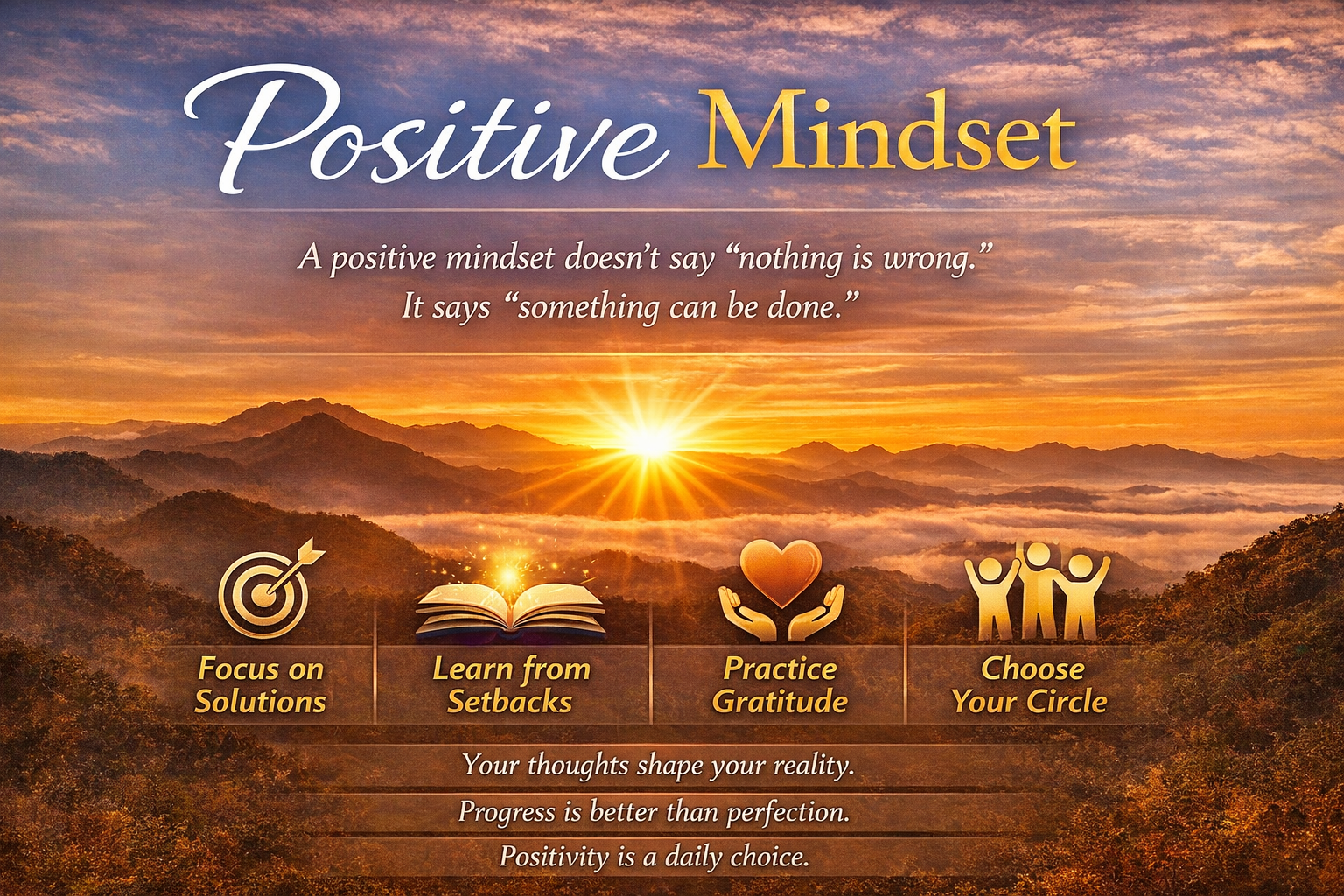
Image by ChatGPT: Manifest Mi Dreams
Introduction - Positive mindset:
A positive mindset is not about ignoring problems, pretending everything is fine, or forcing happiness. It is the ability to face reality with hope, clarity, and solution-oriented thinking.
People often misunderstand positivity as fake optimism. In truth, a positive mindset is mental strength—the ability to stay constructive even when life is difficult.
A positive mindset doesn’t say “nothing is wrong.”
It says “something can be done.”
What a Positive Mindset Really Means:
A positive mindset means:
- You focus on what you can control, not what you can’t
- You look for lessons, not blame
- You believe situations can improve with effort and time
- You respond thoughtfully instead of reacting emotionally
It is not about smiling all the time.
It is about not allowing negativity to decide your actions.
How Positive Mindset Shows Up in Daily Life:
In Career & Work
- Setbacks are seen as temporary, not personal failures
- Feedback is taken as guidance, not insult
- Pressure is handled with calm instead of panic
Instead of saying:
“My career is ruined.”
A positive mindset says:
“This phase is challenging, but not permanent.”
In Money Matters
A negative mindset says:
“Money is always a problem.”
A positive mindset says:
“I may not be where I want to be yet, but I can improve my situation.”
This shift alone changes decisions, habits, and confidence.
In Health
A positive mindset does not deny illness or weakness.
It says:
“What small habit can I improve today?”
That question builds long-term health.
Real-Life Example: The Difference Positivity Makes:
Two people face the same failure.
- One complains, blames luck, and emotionally shuts down.
- The other feels disappointed—but asks:
- “What did this teach me?”
- “What can I do differently next time?”
Same situation.
Different mindset.
Different future.
Life doesn’t respond to circumstances. It responds to interpretation.
Positive Mindset vs Toxic Positivity:
It’s important to know the difference.
Toxic positivity says:
- “Just be positive.”
- “Don’t think negative.”
- “Others have it worse.”
Healthy positive mindset says:
- “This hurts, and I’ll deal with it constructively.”
- “I can feel emotions without being controlled by them.”
Real positivity allows emotions. Fake positivity suppresses them.
Why a Positive Mindset Is Powerful:
A positive mindset:
- Improves decision-making
- Reduces emotional burnout
- Builds resilience
- Attracts better opportunities
- Strengthens relationships
It doesn’t guarantee success—but it increases your chances dramatically.
Simple Ways to Build a Positive Mindset:
- Observe your self-talk
Replace “always” and “never” with realistic language. - Practice gratitude daily
Gratitude trains the brain to notice what’s working. - Limit negative input
Constant complaints, news overload, and comparison weaken positivity. - Focus on solutions
Ask “What can I do now?” instead of “Why me?” - Surround yourself with constructive people
Positivity grows faster in the right environment.
Real-Life Examples: Born Poor, Grew Rich Through Positive Mindset:
- Dhirubhai Ambani (India) – From Petrol Pump Attendant to Business Legend
- Born into a modest family
- Worked as a petrol pump attendant in Yemen
- No elite education, no connections, no capital
What changed his life was not luck—it was vision + optimism + risk-taking mindset.
Even during financial setbacks, Dhirubhai believed:
“If you don’t build your dreams, someone else will hire you to build theirs.”
His positive belief in possibilities led to the creation of one of India’s largest business empires.
- Oprah Winfrey – From Extreme Poverty to Global Influence
- Born into poverty
- Faced abuse, rejection, and discrimination
- Multiple career setbacks early on
Despite everything, Oprah chose hope over bitterness.
She once said:
“The greatest discovery of all time is that a person can change their future by merely changing their attitude.”
Her mindset transformed pain into purpose—and purpose into wealth and impact.
- Howard Schultz (Starbucks) – Grew Up Poor, Built a Global Brand
- Grew up in public housing
- Father struggled with unstable jobs
- Financial insecurity was constant
Instead of developing a victim mindset, Schultz developed empathy + belief.
He used his background as motivation to create a company that valued people, not just profits.
He didn’t escape poverty by ignoring it—he learned from it positively.
- J.K. Rowling – From Welfare to Billionaire Author
- Divorced
- Living on government assistance
- Rejected by multiple publishers
She described herself as:
“As poor as it is possible to be in modern Britain.”
What saved her was faith in her story and persistence.
“Rock bottom became the solid foundation on which I rebuilt my life.”
- Shiv Nadar (HCL Founder) – Middle-Class Beginnings, Visionary Mindset
- Not born wealthy
- Took risks when India’s IT industry was still uncertain
- Faced early struggles and scepticism
His optimism toward India’s future and technology helped build one of the country’s biggest IT companies.
What These Lives Have in Common
They did NOT:
- Start rich
- Have perfect timing
- Avoid failure
They DID:
- Stay hopeful during hardship
- Believe improvement was possible
- Keep taking action despite fear
- Refuse to identify as victims
Positive mindset doesn’t deny pain. It refuses to live inside it.
Book Recommendations: Positive Mindset & Rising from Hardship:
- Mindset — Carol S. Dweck
Explains how belief systems shape success, wealth, and resilience.
- The Power of Positive Thinking — Norman Vincent Peale
A classic on how optimism shapes outcomes.
- Think and Grow Rich — Napoleon Hill
Shows how belief, persistence, and mindset precede wealth.
- You Are a Badass — Jen Sincero
Modern, relatable take on confidence, money mindset, and positivity.
- The Magic of Thinking Big — David J. Schwartz
Teaches how expanding your thinking expands results.
Positive Mindset and Long-Term Success:
Most successful people are not positive because they succeeded.
They succeeded because they stayed positive long enough to continue.
Positivity keeps you in the game when others quit.
Final Reflection:
A positive mindset is not a personality trait.
It is a daily choice.
Some days will be harder than others—but every day you choose a constructive response, you strengthen your inner foundation.
You don’t need a perfect life to think positively.
You need a positive mindset to build a better life.
“Circumstances may shape your starting point, but mindset shapes your destination.” — Manifest Mi Dreams
“Poverty is not just lack of money; it is lack of belief. Once belief changes, money follows.” — Carol Dweck
Manifest Mi Dreams - Team
Related posts:
No related posts.