
Table of Contents
- 1 Introduction: Why Growth Mindset Is the Most Important Skill of the 21st Century:
- 2 What Is a Growth Mindset?
- 3 Fixed Mindset vs Growth Mindset: The Silent Divider of Lives:
- 4 Growth Mindset in Everyday Life: Where Most People Give Up Too Early:
- 5 Real Life Example: The Late Bloomer Professional:
- 6 Sports Example: MS Dhoni — Growth Mindset Under Pressure:
- 7 Entrepreneur Example: Elon Musk — Growth Mindset at the Edge of Failure:
- 8 Growth Mindset in Money, Health, and Relationships:
- 9 Why Growth Mindset Feels Uncomfortable:
- 10 How to Build a Growth Mindset (Practical Steps):
- 11 1. Change Your Inner Dialogue (Self-Talk Awareness):
- 12 2. Focus on Process, Not Just Outcome:
- 13 3. Redefine Failure as Feedback:
- 14 4. Learn to Sit with Discomfort:
- 15 5. Replace Comparison with Self-Competition:
- 16 6. Build Micro-Discipline (Small Daily Commitments):
- 17 7. Seek Feedback Without Defensiveness:
- 18 8. Surround Yourself with Growth-Oriented People:
- 19 9. Respect Time and Patience:
- 20 10. Act Before Confidence Arrives:
- 21 Final Reflection: Growth Mindset Is a Lifetime Advantage:
- 22 Recommended Books to Build a Growth Mindset:
- 23 “The pain of discipline weighs ounces. Regret weighs tons.” — Manifest Mi Dreams
- 24 “Slow progress is still progress, Becoming is better than being.” — Carol Dweck
- 25 Manifest Mi Dreams - Team
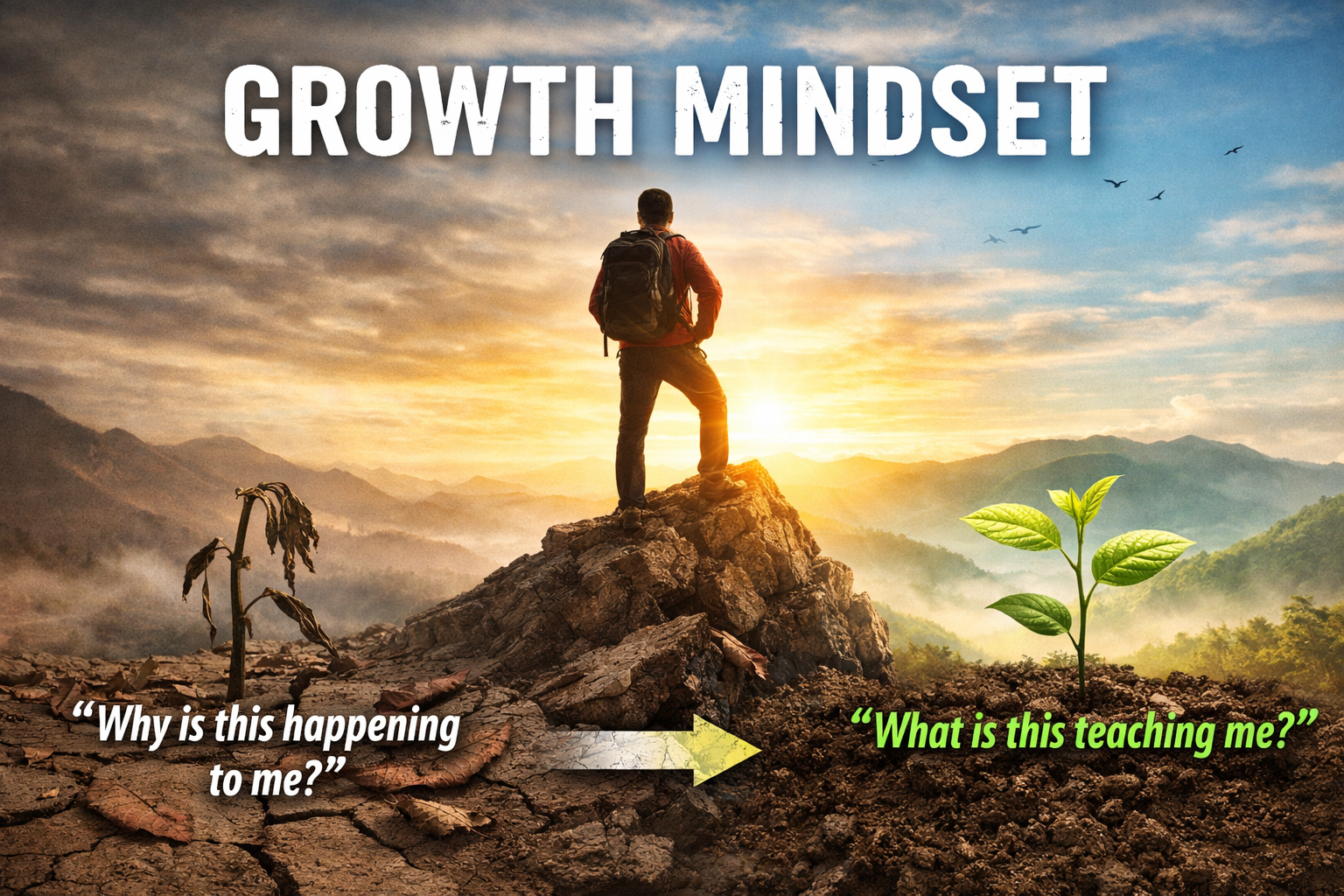
Image by ChatGPT: Manifest Mi Dreams
Introduction: Why Growth Mindset Is the Most Important Skill of the 21st Century:
In a fast‑changing world, skills become outdated, industries collapse, and certainty disappears. What remains constant is one invisible factor that decides who rises, who adapts, and who silently falls behind — mindset.
A growth mindset is not motivation. It is not positive thinking. It is the deep‑rooted belief that abilities, intelligence, emotional strength, financial capacity, and life outcomes can be developed through effort, learning, discipline, and persistence.
People with a growth mindset do not escape struggle — they use struggle as fuel.
“Your mindset determines whether obstacles become walls or stepping stones.”
What Is a Growth Mindset?
A growth mindset means:
- You believe skills can be learned
- You see failure as feedback
- You value progress over perfection
- You stay consistent even when results are invisible
It does not mean you ignore reality. It means you refuse to be limited by it.
In daily life, growth mindset sounds like:
- “I’m not good at this yet.”
- “What can I learn from this mistake?”
- “Slow progress is still progress.”
Growth mindset is the quiet confidence that time and effort are never wasted.
Fixed Mindset vs Growth Mindset: The Silent Divider of Lives:
A fixed mindset believes:
- Talent is fixed
- Failure defines identity
- Effort is pointless if you’re not naturally gifted
A growth mindset believes:
- Talent grows with practice
- Failure is part of mastery
- Effort compounds over time
This difference is subtle in one day — but massive over ten years.
Two people can start at the same place and end up in different worlds — only because of mindset.
Growth Mindset in Everyday Life: Where Most People Give Up Too Early:
Most people don’t fail because they lack ability. They fail because they stop too soon.
- They quit learning when progress feels slow
- They stop trying when validation doesn’t come
- They abandon goals when comparison enters
Growth mindset survives the boring phase — the phase where nothing seems to be working.
The future belongs to those who stay consistent when motivation fades.
Real Life Example: The Late Bloomer Professional:
Consider a man in his late 30s, stuck in the same job for years. Salary stagnates. Confidence declines. Society labels him average.
A fixed mindset whispers:
“This is my limit.”
A growth mindset asks:
“What skill can change my value?”
He begins learning quietly — 30 minutes a day. No applause. No instant results.
After one year, confidence shifts.
After two years, opportunities appear.
After four years, identity changes.
Growth mindset doesn’t change life dramatically — it changes it permanently.
Sports Example: MS Dhoni — Growth Mindset Under Pressure:
MS Dhoni is not just a cricket legend — he is a masterclass in growth mindset.
Coming from a small town, with no godfather in cricket, Dhoni faced criticism for his unconventional style. Instead of reacting emotionally, he focused on learning, adapting, and improving.
As captain, he:
- Trusted players during failure
- Stayed calm in chaos
- Learned from losses instead of defending ego
Dhoni’s strength was not aggression — it was emotional maturity.
World Cups, championships, and legendary status followed because he played the long game.
Entrepreneur Example: Elon Musk — Growth Mindset at the Edge of Failure:
Elon Musk’s story is often misunderstood as genius‑driven success. In reality, it is failure‑driven growth.
Before success:
- Rockets exploded
- Companies nearly collapsed
- Personal finances were at risk
A fixed mindset would retreat.
“What did this failure teach?”
He reinvested lessons, not fear.
Failure didn’t break him — it trained him.
Today, Tesla and SpaceX redefine industries once thought impossible.
Growth Mindset in Money, Health, and Relationships:
Money
Growth mindset sees income as expandable through skill and patience.
Health
Small habits beat genetic excuses.
Relationships
Emotional intelligence grows through awareness and effort.
Growth mindset treats every area of life as trainable.
Why Growth Mindset Feels Uncomfortable:
Because it removes excuses.
If growth is possible, responsibility returns to you.
Comfort is attractive — growth is transformative.
How to Build a Growth Mindset (Practical Steps):
Building a growth mindset is not a one-time decision. It is a daily practice — shaped by how you think, react, speak to yourself, and respond to setbacks. Below are practical, real-world steps that gradually rewire your thinking and behaviour.
There are 10 Practical Steps, let’s go through one by one:
1. Change Your Inner Dialogue (Self-Talk Awareness):
Your mind is constantly talking — whether you listen or not. A fixed mindset uses absolute language:
- “I can’t do this.”
- “I’m not smart enough.”
- “This always happens to me.”
A growth mindset adds one powerful word: yet.
- “I can’t do this yet.”
- “I don’t understand this yet.”
This small shift keeps possibility alive.
You don’t need positive self-talk. You need honest, flexible self-talk.
2. Focus on Process, Not Just Outcome:
Most people judge themselves only by results. Growth-minded people judge themselves by effort, learning, and consistency.
Instead of asking:
- “Did I succeed?”
Ask:
- “Did I show up?”
- “Did I learn something?”
- “Did I improve slightly?”
When process becomes the goal, results eventually follow.
Fall in love with effort, and outcomes will chase you.
3. Redefine Failure as Feedback:
Failure hurts only when it attacks identity.
A fixed mindset says:
“I failed because I’m not capable.”
A growth mindset says:
“This result is data. What does it teach me?”
Every failure contains instructions — if ego does not block learning.
Failure is not the opposite of success. It is part of the path.
4. Learn to Sit with Discomfort:
Growth feels uncomfortable because it stretches identity.
- Learning feels slow
- Progress feels invisible
- Doubt feels loud
Most people quit here.
Growth mindset trains patience — understanding that discomfort is not danger.
If it feels uncomfortable, it’s probably working.
5. Replace Comparison with Self-Competition:
Comparison kills growth because it ignores different timelines.
Growth mindset asks:
- “Am I better than I was last year?”
- “Did I act with discipline today?”
You don’t need to beat others. You need to outgrow your past self.
Your only real competition is who you were yesterday.
6. Build Micro-Discipline (Small Daily Commitments):
Growth does not come from heroic actions — it comes from boring consistency.
- 20 minutes of learning daily
- 10 minutes of reflection
- One difficult task completed honestly
These small actions compound quietly.
Discipline is choosing long-term respect over short-term comfort.
7. Seek Feedback Without Defensiveness:
Fixed mindset avoids feedback because it feels like judgment.
Growth mindset welcomes feedback because it accelerates learning.
Instead of defending mistakes, ask:
- “What can I improve?”
- “What did I miss?”
Feedback is not an attack — it is free education.
8. Surround Yourself with Growth-Oriented People:
Mindsets are contagious.
If your environment normalizes excuses, stagnation feels safe.
If it normalizes effort, growth feels natural.
Choose conversations that expand you.
Your environment either stretches you or shrinks you.
9. Respect Time and Patience:
Growth mindset understands one core truth:
Nothing meaningful grows fast.
People often underestimate what they can achieve in 5 years because they overestimate what they can do in 6 months.
Stay patient. Stay consistent.
10. Act Before Confidence Arrives:
Confidence is not a prerequisite for action. It is a result of action.
Growth mindset moves despite fear.
You don’t wait to feel ready. You grow by starting.
Final Reflection: Growth Mindset Is a Lifetime Advantage:
A growth mindset does not promise easy success.
It promises possible success.
Years from now, you won’t remember how fast you moved — only that you didn’t quit.
Your mindset today is designing your life tomorrow.
Recommended Books to Build a Growth Mindset:
- Mindset: The New Psychology of Success — Carol S. Dweck
The foundational book that explains how fixed and growth mindsets shape success, failure, learning, and life outcomes. - Atomic Habits — James Clear
Shows how small daily habits and systems create massive long-term growth—practical and easy to apply. - Grit — Angela Duckworth
Explains why perseverance and consistency matter more than talent or intelligence. - Deep Work — Cal Newport
Teaches how focus and skill-building in a distracted world give you a long-term advantage. - The Obstacle Is the Way — Ryan Holiday
A powerful mindset book on turning challenges, failures, and delays into strength.
“The pain of discipline weighs ounces. Regret weighs tons.” — Manifest Mi Dreams
“Slow progress is still progress, Becoming is better than being.” — Carol Dweck
Manifest Mi Dreams - Team
Related posts:
No related posts.