
Table of Contents
- 1 Introduction – The Hidden Architecture of Manifestation
- 2 Part 1: Understanding the Two Dimensions of the Mind
- 3 Part 2: The Conscious Mind – The Power of Intention
- 4 Part 3: The Subconscious Mind – The Silent Creator
- 5 Part 4: How the Two Minds Interact
- 6 Part 5: The Science of Belief and Neuroplasticity
- 7 Part 6: Emotional Frequency and Vibrational Alignment
- 8 Part 7: Meditation – The Bridge Between Conscious and Subconscious
- 9 Part 8: Tools to Reprogram the Subconscious Mind
- 10 Part 9: Common Blocks in Manifestation:
- 11 Part 10: Integrating Mindfulness into Daily Manifestation
- 12 Part 11: The Final Alignment – Becoming the Conscious Creator:
- 13 Conclusion – Your Mind Is the Manifestation Engine
- 14 “The conscious mind is the captain, steering the ship of life with thoughts and decisions.” — Joseph Murphy
- 15 “Faith bridges the conscious desire and subconscious belief.” — Dr. Joseph Murphy
- 16 “When the conscious and subconscious minds agree, manifestation becomes effortless.” — Neville Goddard
- 17 Manifest Mi Dreams - Team
Introduction – The Hidden Architecture of Manifestation
Everything you see in your outer world begins in the inner world of your mind. Every desire, dream, and goal you wish to manifest starts as a thought — a pulse of energy born within your consciousness. But manifestation isn’t just wishful thinking or repeating affirmations; it’s a precise process governed by how your conscious and subconscious minds work together.
Your conscious mind is the creator of intention, the one that decides what you want.
Your subconscious mind is the executor, the one that takes those intentions and turns them into habits, emotions, and external results.
When both work in harmony, manifestation feels effortless. But when they are in conflict — when your subconscious beliefs don’t match your conscious desires — manifestation feels blocked, slow, or inconsistent.
Understanding this relationship is the secret to mastering manifestation not as a mystical event, but as a natural psychological and energetic process.
Let’s explore how these two parts of the mind function, interact, and ultimately shape the reality you live every day.
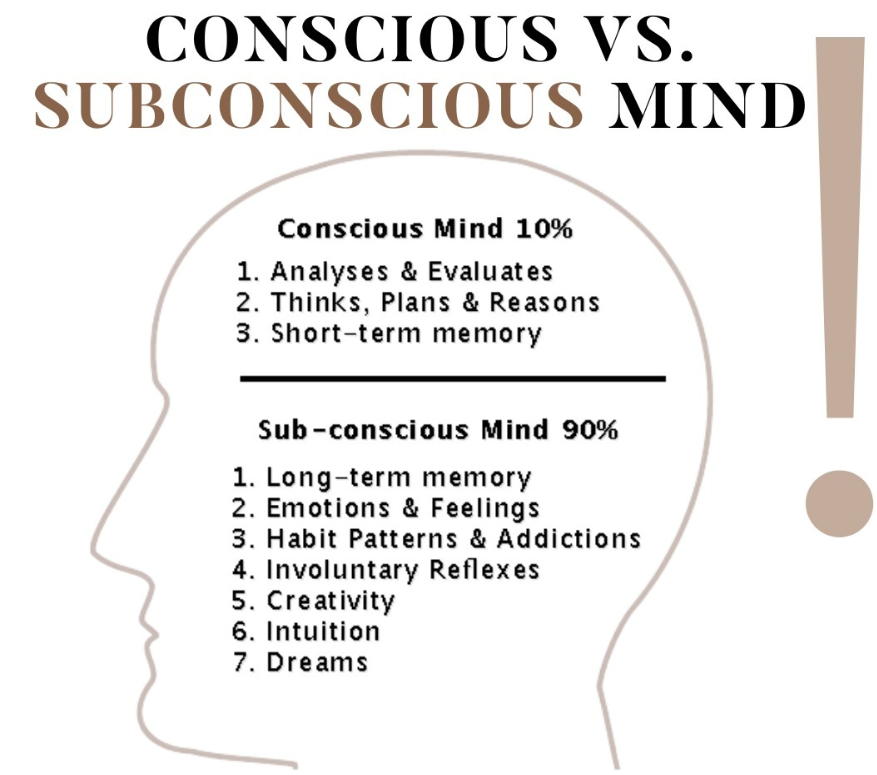
Image by: Pexels
Part 1: Understanding the Two Dimensions of the Mind
The human mind has two primary aspects:
- The Conscious Mind – the rational, thinking, analytical part of your awareness.
- The Subconscious Mind – the emotional, automatic, and deeply creative layer beneath the surface.
Psychologists often compare the mind to an iceberg — only the small visible tip represents the conscious mind, while the vast portion below the surface represents the subconscious.
- The conscious mind controls about 5% of your mental activity.
- The subconscious mind influences about 95% of your behaviour, emotions, and decisions.
That means your subconscious mind is running the show most of the time — silently guiding what you think, attract, and become.
Part 2: The Conscious Mind – The Power of Intention
The conscious mind is your present awareness — the part of you that can decide, choose, and plan. It operates through logic, reasoning, and focus.
When you say, “I want to manifest financial freedom,” that intention is born in the conscious mind.
Functions of the Conscious Mind:
- Sets goals and desires.
- Chooses thoughts deliberately.
- Engages in critical thinking and analysis.
- Directs focus and attention.
However, the conscious mind has limited processing capacity. It can hold only a few thoughts at a time and gets easily distracted. That’s why willpower alone isn’t enough to create lasting change — you can’t consciously force your mind to stay positive 24/7.
To manifest successfully, your conscious mind must train and reprogram the subconscious mind to align with your vision.
Part 3: The Subconscious Mind – The Silent Creator
Your subconscious mind is the powerful unseen force that governs nearly all of your life. It stores every memory, belief, and emotional imprint from your past — especially from childhood.
It doesn’t reason or analyze; it simply accepts what you believe most strongly and brings it into reality through emotion and behavior.
Key Characteristics of the Subconscious Mind:
- Operates automatically and emotionally.
- Controls habits, patterns, and bodily functions.
- Works 24/7 — even while you sleep.
- Responds to imagination and repetition.
- Cannot distinguish between real and imagined experiences.
Because of this, if you consistently visualize a new reality and feel it deeply, your subconscious will start accepting it as truth — and then reorganize your behavior, perception, and energy to match that inner image.
This is the real science behind manifestation:
Whatever you impress upon your subconscious mind with emotion and repetition must eventually express itself as your reality.
Part 4: How the Two Minds Interact
Think of your conscious mind as a programmer and your subconscious as the supercomputer. The conscious mind sends instructions, and the subconscious carries them out — without question.
When your conscious mind focuses on positive, goal-oriented thoughts, your subconscious starts to act accordingly.
But if your conscious mind constantly entertains fear, doubt, or negativity, the subconscious manifests that instead.
The Cycle of Manifestation:
- Conscious Thought – “I desire abundance.”
- Emotional Charge – You imagine it with feeling.
- Subconscious Acceptance – Repeated visualization becomes belief.
- Behavioural Alignment – Your habits and actions shift.
- Physical Reality – The outer world mirrors the inner program.
That’s why reflection, mindfulness, and meditation are crucial — they allow you to observe what thoughts you’re programming into your subconscious.
Part 5: The Science of Belief and Neuroplasticity
Your brain is not fixed. It’s neuroplastic — it constantly rewires itself based on what you think and feel repeatedly.
Each time you visualize your dream, repeat affirmations, or feel gratitude, you strengthen neural pathways associated with abundance, joy, and confidence.
Conversely, when you dwell on fear or failure, you reinforce neural networks of lack and limitation.
In neuroscience, the principle is simple:
“Neurons that fire together, wire together.”
This means your repeated thoughts and emotions literally sculpt your brain — turning your manifestation practice into a biological reality.
Mindfulness and reflection enhance this process by creating awareness — you become conscious of your mental patterns, and once you are aware, you can change them.
Part 6: Emotional Frequency and Vibrational Alignment
Your subconscious mind doesn’t respond to logic; it responds to emotion and vibration.
When you visualize something with genuine joy, excitement, and gratitude, you’re broadcasting a high-frequency emotional signal that magnetically attracts matching experiences.
In energetic terms:
- Fear, worry, and lack operate at low frequencies.
- Love, gratitude, and joy operate at high frequencies.
Your subconscious acts like a magnet that draws experiences equal to your dominant vibration. That’s why gratitude and mindfulness are the two most powerful emotional states for manifestation — they harmonize your inner frequency with your desired reality.
Part 7: Meditation – The Bridge Between Conscious and Subconscious
Meditation is the gateway where your conscious and subconscious minds meet.
In deep meditation, your brain shifts from beta (active thinking) to alpha and theta brainwave states — the same states where your subconscious becomes open and impressionable.
When you meditate on your goals or repeat affirmations in this state, you bypass conscious resistance and speak directly to your subconscious.
Benefits of Meditation for Manifestation:
- Calms the amygdala (reducing fear and doubt).
- Enhances focus and creative visualization.
- Opens access to the subconscious mind.
- Increases dopamine and serotonin, raising your emotional frequency.
- Aligns your heart and brain coherence.
Over time, meditation builds a powerful alignment between your intention (conscious) and your vibration (subconscious), making manifestation natural and effortless.
Part 8: Tools to Reprogram the Subconscious Mind
To align your subconscious with your manifestation goals, you must reprogram it through repetition, emotion, and focus. Here are the most effective tools:
- Visualization
Imagine your desired reality as if it’s happening now. Engage all senses — see, hear, feel, and believe.
- Affirmations
Repeat positive statements daily, especially in the alpha/theta states (just after waking or before sleep).
- Gratitude Practice
Feel thankful for what you already have and for what’s coming. Gratitude creates emotional harmony with abundance.
- Reflective Journaling
Write down your thoughts, beliefs, and emotional reactions. Awareness transforms old subconscious patterns.
- Mindfulness
Stay present throughout your day. The more aware you are, the less you repeat unconscious patterns.
- Subconscious Rehearsal
Before sleeping, mentally rehearse the day you want to experience tomorrow. The subconscious will manifest accordingly.
Part 9: Common Blocks in Manifestation:
Even with practice, some people struggle to manifest because of inner resistance. Here are the most common blocks:
- Limiting Beliefs – Deep-rooted beliefs like “I’m not worthy” or “Money is hard to get” block abundance.
- Emotional Resistance – Unresolved pain or trauma lowers vibration and creates inner conflict.
- Inconsistent Focus – Shifting goals and energy confuse the subconscious.
- Overthinking – Too much logic activates doubt and breaks emotional flow.
- Lack of Faith – The subconscious responds to certainty, not hesitation.
The remedy is awareness, mindfulness, and self-compassion. The more you reflect and meditate, the more your subconscious learns safety and openness to new realities.
Part 10: Integrating Mindfulness into Daily Manifestation
Mindfulness isn’t a ritual — it’s a way of life. It keeps you aware of your thoughts, emotions, and energy throughout the day.
Practical Mindfulness for Manifestation:
- Begin your day with 5 minutes of conscious breathing.
- Notice any self-talk that feels limiting and gently replace it.
- Practice gratitude while walking, eating, or working.
- Visualize your goals not as distant dreams but as current truths.
- Before sleep, silently thank the universe and your subconscious for guiding you.
With consistent mindfulness, you’ll notice that the gap between your intention and manifestation becomes smaller.
Part 11: The Final Alignment – Becoming the Conscious Creator:
When your conscious mind (thoughts and intentions) and your subconscious mind (beliefs and feelings) become aligned, manifestation stops being effortful. You start to live in flow — a state where the universe, your energy, and your actions move together toward your purpose.
At this stage:
- You stop chasing outcomes.
- You begin to attract naturally.
- You experience peace, clarity, and synchronicity.
You become a conscious creator — someone who knows how to direct their inner world to shape the outer one.
Conclusion – Your Mind Is the Manifestation Engine
Everything you desire already exists as potential energy in the quantum field.
Your conscious mind defines what you want.
Your subconscious mind determines how deeply you believe it’s possible.
The moment your belief and desire merge, manifestation begins.
Your job is not to fight for what you want — it’s to align your inner frequency with it through reflection, mindfulness, and meditation.
When your conscious thoughts are focused and your subconscious beliefs are aligned, you become unstoppable. You no longer hope for miracles — you become the miracle.
“As within, so without. As above, so below. As the mind believes, so the world reflects.”
“The conscious mind is the captain, steering the ship of life with thoughts and decisions.” — Joseph Murphy
“Faith bridges the conscious desire and subconscious belief.” — Dr. Joseph Murphy
“When the conscious and subconscious minds agree, manifestation becomes effortless.” — Neville Goddard
Manifest Mi Dreams - Team
Related posts:
No related posts.